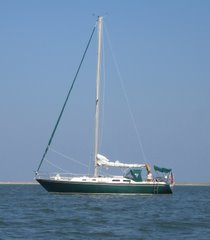
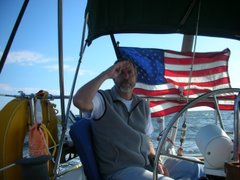
We actually spent a night at the dock--the first time this year I think! We arrived about 330pm, and while putting away the groceries, Bob noticed the refrigerator wasn't working, so the first chore was reconnecting the wire to the compressor that we had aparently pulled loose while feeding the wire for the new inverter dashboard that came along with the new inverter. Once Bob had unfolded himself from the lazarette, we proceeded with some minor chores, while the wind blew and gusted straight down the creek.
While we had originally intended to anchor out, we chickened out in the face of the gusty winds and stayed tied to the dock. Next morning, after re-installing the two rebuilt mast winches, we had to rush into the Bean for coffee. Not only were we completely out of coffee, we ran out of propane while cooking breakfast. Another trip where we were glad we didn't have any visitors.
A quick stop at the newly-revived Oriental In-Water Boat Show set us (ok, me and Abby) to dreaming about newer boats. After shopping a bit, however, we returned to Aquila pretty happy with what we have, at least for now.
We decided, after all, to take a quick sail. It was still quite windy in the creek, but once we got onto the Neuse, the wind dropped. And then dropped some more. We sailed slowly over toward Turnagain Bay and the bombing target, tacked back to Broad Creek, and just as we entered the creek, the wind picked up again. Was it coincidence, or had it really been windier all day in the creek than out of it?
Monday, April 20, 2009

Sunday, November 23, 2008
Installed, but not composting. Yet.
On Friday night after work we drove down to the boat, with the dual objectives of (1) installing the composting head, and (2) 'winterizing' the boat.
The forecast temp for Friday night in Oriental was 25F, the coldest yet this year. After all the cold weather we have been having, we were concerned that the water temps might be cool enough to allow stuff in the boat to freeze. Our winterizing involves setting up the dehumidifier in the head (keeps air a few degrees warmer than ambient) and a temperature-controlled outlet that will turn on a 25W light bulb in the engine compartment and a small electric heater on the floor.
The other job for the weekend was to install the composting head, with the vent and the electricity for the fan. Bob had purchased a whole pile of parts that we might use to connect the compost chamber up to the solar vent in the hatch.
It was cold when we arrived, but the stars (Orion and the Milky Way) were beautiful. We first removed the inflatable kayak we have been stowing in the cabin. Given the water temps, we later decided it was time to put the kayak up for the winter. We might still get it out if the weather is nice, but chances are slim that we will use it often. We set up the two electric heaters, put the extra blankets on the beds, and settled in for the night.
Bob, as usual, was up early getting the parts out of the car for the installation. The base he had made out of starboard was perfect, and after a quick test to make sure we could get the top off (necessary to empty both the liquid and solids tanks), he installed the toilet. Then we started working on the routing of the vent hose from the toilet to the solar fan, which is mounted in the lexan of the cast bomar overhead hatch.
Our head is very small, and to get the door to open fully we had to raise the toilet 1.5inches and turn it slightly sideways. We had a similar issue with the vent. Bob attached some kind of plumbing piece to the vent, then a pvc elbow, but he had to sand the bottom of the elbow a bit so the door would close! Eventually, with a combination of flexible hose and rigid pvc it was all connected. Of course, we have only an intake fan blade for the solar vent, so it's still not quite usable. Bob also connected the small fan in the toilet base to our 12v system so we can use that fan if the other doesn't work all the time.
We cleaned up, set up the heater, and when we come back with the right fan blade we'll be all set.
The forecast temp for Friday night in Oriental was 25F, the coldest yet this year. After all the cold weather we have been having, we were concerned that the water temps might be cool enough to allow stuff in the boat to freeze. Our winterizing involves setting up the dehumidifier in the head (keeps air a few degrees warmer than ambient) and a temperature-controlled outlet that will turn on a 25W light bulb in the engine compartment and a small electric heater on the floor.
The other job for the weekend was to install the composting head, with the vent and the electricity for the fan. Bob had purchased a whole pile of parts that we might use to connect the compost chamber up to the solar vent in the hatch.
It was cold when we arrived, but the stars (Orion and the Milky Way) were beautiful. We first removed the inflatable kayak we have been stowing in the cabin. Given the water temps, we later decided it was time to put the kayak up for the winter. We might still get it out if the weather is nice, but chances are slim that we will use it often. We set up the two electric heaters, put the extra blankets on the beds, and settled in for the night.
Bob, as usual, was up early getting the parts out of the car for the installation. The base he had made out of starboard was perfect, and after a quick test to make sure we could get the top off (necessary to empty both the liquid and solids tanks), he installed the toilet. Then we started working on the routing of the vent hose from the toilet to the solar fan, which is mounted in the lexan of the cast bomar overhead hatch.
Our head is very small, and to get the door to open fully we had to raise the toilet 1.5inches and turn it slightly sideways. We had a similar issue with the vent. Bob attached some kind of plumbing piece to the vent, then a pvc elbow, but he had to sand the bottom of the elbow a bit so the door would close! Eventually, with a combination of flexible hose and rigid pvc it was all connected. Of course, we have only an intake fan blade for the solar vent, so it's still not quite usable. Bob also connected the small fan in the toilet base to our 12v system so we can use that fan if the other doesn't work all the time.
We cleaned up, set up the heater, and when we come back with the right fan blade we'll be all set.
Wednesday, November 12, 2008
Buying some, selling some
Bob has ordered the starboard (about $70 worth),and the step stool ($22 from West Marine) for the new head. We just sold the old toilet, the old CruiseAir, and the old CPT autopilot for $50, so it's a net loss of 42$ on the day. Now there's enough room in the sailing closet for the spare alternator, starter, storm jib, paratech drogue, third anchor/chain/line, extra life jackets (we have 11 on board), spare stay/shroud, and who knows what else.
Monday, November 10, 2008
Going green
Is it still unclear to me whether 'going green' in this circumstance means we are becoming more sustainable in our boating, or if it means we will be suffering from nausea because of dealing with a composting toilet. But we have decided to give it a try.
Yesterday, we took the boat out for a sail(recall that we had removed the holding tank last weekend, and so had only a bucket to use as a toilet) and spent the early part of the day sailing on the Neuse River. It was wonderful, except the holding tank smell had not abated, even without the tank. Unfortunately, we still had the hoses, and the toilet, and the pump-overboard pump in the head and under the vberth. It was not pleasant.
So, when we returned to the Boonedocks, we called Tom at Below the Decks in Oriental, and he brought out the composting toilet to see if it would fit in our tiny head. This required that we remove the hoses (more yuck) and the toilet (double yuck).
The Nature's Head is 20" tall, 18" front to back, and about 18" wide. Our head is just aft of the vberth, and the base for our current toilet ranges from 8" to 13" deep (the wide part is aft, with an angle up from the base following the contour hull, is 22" wide and is a raised platform (internal fiberglass pan) of about 3". The only way we could make it fit was to raise it 1.5" and angle it slightly. We bought the toilet, and Bob is making a base out of starboard.
With the 20" height, the 3" platform, and the new 1.5" base, the seat is now 24.5 inches off the floor. Compare this to your typical household toilet, which is 13" or so off the floor. We are going to get or make a step so that at least some of us can rest our feet on the step while using the toilet, or perhaps use the step to get up on the toilet. Weird things to write about...
Next trip out to the boat, I expect we will install the base, install the fan, pour in the slightly moistened peat moss, and...use it! Which is great, because the bucket idea was not popular with our 10 year old.
Yesterday, we took the boat out for a sail(recall that we had removed the holding tank last weekend, and so had only a bucket to use as a toilet) and spent the early part of the day sailing on the Neuse River. It was wonderful, except the holding tank smell had not abated, even without the tank. Unfortunately, we still had the hoses, and the toilet, and the pump-overboard pump in the head and under the vberth. It was not pleasant.
So, when we returned to the Boonedocks, we called Tom at Below the Decks in Oriental, and he brought out the composting toilet to see if it would fit in our tiny head. This required that we remove the hoses (more yuck) and the toilet (double yuck).
The Nature's Head is 20" tall, 18" front to back, and about 18" wide. Our head is just aft of the vberth, and the base for our current toilet ranges from 8" to 13" deep (the wide part is aft, with an angle up from the base following the contour hull, is 22" wide and is a raised platform (internal fiberglass pan) of about 3". The only way we could make it fit was to raise it 1.5" and angle it slightly. We bought the toilet, and Bob is making a base out of starboard.
With the 20" height, the 3" platform, and the new 1.5" base, the seat is now 24.5 inches off the floor. Compare this to your typical household toilet, which is 13" or so off the floor. We are going to get or make a step so that at least some of us can rest our feet on the step while using the toilet, or perhaps use the step to get up on the toilet. Weird things to write about...
Next trip out to the boat, I expect we will install the base, install the fan, pour in the slightly moistened peat moss, and...use it! Which is great, because the bucket idea was not popular with our 10 year old.
Thursday, November 6, 2008
Keeping the wenches and winches happy
Bob really tries to keep me happy with the boat. I think I'm perfectly reasonable, have only safety in mind, and never ask for more than we can afford. Bob...well, he sees things a little differently.
This last weekend we spent another work day at the boat, servicing the main halyard winch, taking the two mast winches off (not trivial), calibrating the tachometer (ick). Once these jobs were finished, we discussed which job would be next. Previously, we had decided that we needed a larger holding tank, and the easy thing (Bob's idea of easy, not mine) would be to build our own holding tank. In addition,there was something smelly on board...
The holding tank it was.
We cleaned out the vberth (aka the garage), opened up the storage area that keeps the holding tank out of way, and yes, discovered the source of the smell. At some time recently, the holding tank had...exploded. Probably because it was overfull, the seal on the clean out had...uh, was...uh, it was disgusting.
We took out the holding tank. Cleaned up the mess in the vberth. Dropped the holding tank in the trash at the Boonedocks. And drove home.
Then I got started thinking about pump-outs, lectra-sans, and composting toilets. Technology has failed me: there aren't any good solutions yet. But I checked into the composters, again.
There are composting toilets specifically designed for boats. Typically, they require some electricity to power a vent (though a solar vent can be used). In the words of one user, composters also require the sailor to get 'up close and personal' with their excrement. The plusses are (1) no pump outs, (2) no through hulls, (3) nothing to leak or clog, (4) no smelly creek water in the system (a big part of our smelly head problem is due to the creek water we use for flushing). The minuses are (1) no pump outs, (2) seeing and living with the poop, (3) dumping the compost when the time comes, (4) dumping the urine bottle frequently (every 2-3 days).
So, envision this. A week long trip through the Pamlico Sound. Composter fills up and we...I don't know. I guess we empty it BEFORE we go. Or this. A three week trip to Bermuda. Composter fills up and we dump it outside the 3 or 6 or 12 mile limit. We dump the urine overboard every other day (be sure you dump it on the leeward side of the boat, please). Once at anchor in St. Georges, we have to sneak our urine bottle into a cloth grocery bag (never again to be used for groceries?) every other day and take it to the public toilets at the visitor's center to pour it into the toilets there. If we are only in Bermuda a week, the composter will be fine (actually, it might be fine for the whole three weeks depending on how many of us there are!)
On the Bermuda trip, the alternative with a holding tank is this: dump outside the three mile limit from the US and pump overboard (this is an invisible operation!) every day or two while at sea. While at anchor in St. Georges, we can either hire a pump-out boat (I have yet to find one in St. Georges), go to a dock with a pump-out (I have yet to find one in St. Georges), or go for a day sail every other day out beyond the 12 mile limit to dump the holding tank. Hmmm, not a pretty scenario. Alternatively, we could dump before entering Bermuda waters, dock at the Dinghy Dock and take the 1/4 mile hike to the bathroom (saving the holding tank space for nighttime use only). One week at the dock is about $500. Sigh. No easy answers.
This last weekend we spent another work day at the boat, servicing the main halyard winch, taking the two mast winches off (not trivial), calibrating the tachometer (ick). Once these jobs were finished, we discussed which job would be next. Previously, we had decided that we needed a larger holding tank, and the easy thing (Bob's idea of easy, not mine) would be to build our own holding tank. In addition,there was something smelly on board...
The holding tank it was.
We cleaned out the vberth (aka the garage), opened up the storage area that keeps the holding tank out of way, and yes, discovered the source of the smell. At some time recently, the holding tank had...exploded. Probably because it was overfull, the seal on the clean out had...uh, was...uh, it was disgusting.
We took out the holding tank. Cleaned up the mess in the vberth. Dropped the holding tank in the trash at the Boonedocks. And drove home.
Then I got started thinking about pump-outs, lectra-sans, and composting toilets. Technology has failed me: there aren't any good solutions yet. But I checked into the composters, again.
There are composting toilets specifically designed for boats. Typically, they require some electricity to power a vent (though a solar vent can be used). In the words of one user, composters also require the sailor to get 'up close and personal' with their excrement. The plusses are (1) no pump outs, (2) no through hulls, (3) nothing to leak or clog, (4) no smelly creek water in the system (a big part of our smelly head problem is due to the creek water we use for flushing). The minuses are (1) no pump outs, (2) seeing and living with the poop, (3) dumping the compost when the time comes, (4) dumping the urine bottle frequently (every 2-3 days).
So, envision this. A week long trip through the Pamlico Sound. Composter fills up and we...I don't know. I guess we empty it BEFORE we go. Or this. A three week trip to Bermuda. Composter fills up and we dump it outside the 3 or 6 or 12 mile limit. We dump the urine overboard every other day (be sure you dump it on the leeward side of the boat, please). Once at anchor in St. Georges, we have to sneak our urine bottle into a cloth grocery bag (never again to be used for groceries?) every other day and take it to the public toilets at the visitor's center to pour it into the toilets there. If we are only in Bermuda a week, the composter will be fine (actually, it might be fine for the whole three weeks depending on how many of us there are!)
On the Bermuda trip, the alternative with a holding tank is this: dump outside the three mile limit from the US and pump overboard (this is an invisible operation!) every day or two while at sea. While at anchor in St. Georges, we can either hire a pump-out boat (I have yet to find one in St. Georges), go to a dock with a pump-out (I have yet to find one in St. Georges), or go for a day sail every other day out beyond the 12 mile limit to dump the holding tank. Hmmm, not a pretty scenario. Alternatively, we could dump before entering Bermuda waters, dock at the Dinghy Dock and take the 1/4 mile hike to the bathroom (saving the holding tank space for nighttime use only). One week at the dock is about $500. Sigh. No easy answers.
Monday, October 13, 2008
Size isn't everything
Last weekend we were planning on going to Ocracoke. We had even invited some friends to go with us. Luckily for them, they had 'other plans'.
We got to the boat at about 1130, and were ready to depart at 1230. The forecast was for winds 10-15 from the NE throughout the weekend. As Ocracoke is precisely NE from our dock, this would mean tacking, or motoring, the whole day. It was blowing about 5-10 at the dock, just as we expected.
But when we got out into the open waters of the Neuse, it was more like 15-20, with gusts to 25. And the 'Pamlico Chop' was a frenzy of short interval, steep sided swells that would, depending on our direction, roll the boat from rail-to-rail or pound the boat with shuddering crashes as we popped from up on one wave to down on the next. So we decided to go in the one direction where the chop didn't matter so much--southwest.
We headed into one of our favorite Neuse River anchorages, the South River, sailing at 6 knots in 20 knots of wind (real sailors would tell you the TRUE wind, but I can only give you the APPARENT wind, sigh) with only about 60% of the genoa out, and no main.
This time we checked the anchor set twice, as we didn't want to be dragging in these winds. We were enjoying ourselves, but were glad not to have to cater to guests in this unsettled weather. We still weren't sure what we would do the next day, but sailing to Oriental for the day was a popular alternative.
Until, that is, it rained all night and the forecast for all of Saturday was more of the same. The wind was still forecast at 15-20 knots. The waves were still forecast at 2-3 feet (size isn't everything, those nasty waves from yesterday were only "2-3 feet" as well). We headed back to the dock, and while still raining and blowing, it seemed calm and quiet compared to the soup-bowl out on the Neuse.
We DROVE to Oriental in the rain, and arrived happy and dry at the Bean for our ice cream and coffee. I immediately pulled out my ipod touch, checked the stock market results for Friday (bad, but I still had a few dollars in my retirement account) and then checked out Harbor Cam at towndock.net and there was our car parked on Hodges Street! And there we were walking up to the Bean in our yellow rain jackets! Instant gratification.
The rest of the weekend was spent accomplishing chores of no great interest, except for the winch maintenance. It's hard to call it maintenance when we've had the boat for over three years and this is the first time we have delved into the winches.
We have 7 winches, 2 Barient 28s as secondaries and 2 Barient 18s on the mast that were original equipment. That means they are 20 years old. The primaries and main are self tailing Lewmars. Bob decided to tackle the Barient 28's first.
Sunday morning was MUCH nicer, occassional sprinkles, and finally, some blue skies. Which was good, because the winch disassembly was much harder than anticipated. At one point we had most of our neighbors over watching as we used the crowbar to pry off the winch insides. These are big, sturdy winches, and if that part had suddenly come loose...it would have made a big splash. If that had happened, I'm sure we would have replaced them with smaller, self tailing winches, because, you know, size isn't everything.
At last, with lots of effort and lots of PB Blaster, we got both Barients partly disassembled. Our neighbor checked out the B28 schematic online, and sure enough, those parts that looked welded together were just RUSTED together. We decided to work on separating these pieces once we were at home.
While we (mostly Bob) worked on the winches, our neighbors Josh and his dad Terry, taking a 'boys weekend', having finished their replacement of the exhaust system on their boat, had taken up fishing from the dock. Earlier, we had seen real fishermen, in real fishing boats, hanging around our dock claiming to have caught sizable fish (to them, size WAS everything).
All Josh and Terry caught were pinfish. Granted, some of these pinfish were whoppers, 4-5" long. At one point, the two got into a discussion over who had caught the smallest fish ever. Some of them were really, really small. This was just sportfishing--catch and release only--once again, size isn't everything. Except when the fish was so small they could hardly get the hook out of it's mouth. When we left, Terry was rummaging around in his lazarette. "I'm sure I've got a fighting harness in here somewhere".
The sun was shining as we left Aquila for another two weeks at home. Hopefully the next fall weekend will be more like fall and less like winter, but since we will be putting the winches back together, maybe the weather is irrelevant.
We got to the boat at about 1130, and were ready to depart at 1230. The forecast was for winds 10-15 from the NE throughout the weekend. As Ocracoke is precisely NE from our dock, this would mean tacking, or motoring, the whole day. It was blowing about 5-10 at the dock, just as we expected.
But when we got out into the open waters of the Neuse, it was more like 15-20, with gusts to 25. And the 'Pamlico Chop' was a frenzy of short interval, steep sided swells that would, depending on our direction, roll the boat from rail-to-rail or pound the boat with shuddering crashes as we popped from up on one wave to down on the next. So we decided to go in the one direction where the chop didn't matter so much--southwest.
We headed into one of our favorite Neuse River anchorages, the South River, sailing at 6 knots in 20 knots of wind (real sailors would tell you the TRUE wind, but I can only give you the APPARENT wind, sigh) with only about 60% of the genoa out, and no main.
This time we checked the anchor set twice, as we didn't want to be dragging in these winds. We were enjoying ourselves, but were glad not to have to cater to guests in this unsettled weather. We still weren't sure what we would do the next day, but sailing to Oriental for the day was a popular alternative.
Until, that is, it rained all night and the forecast for all of Saturday was more of the same. The wind was still forecast at 15-20 knots. The waves were still forecast at 2-3 feet (size isn't everything, those nasty waves from yesterday were only "2-3 feet" as well). We headed back to the dock, and while still raining and blowing, it seemed calm and quiet compared to the soup-bowl out on the Neuse.
We DROVE to Oriental in the rain, and arrived happy and dry at the Bean for our ice cream and coffee. I immediately pulled out my ipod touch, checked the stock market results for Friday (bad, but I still had a few dollars in my retirement account) and then checked out Harbor Cam at towndock.net and there was our car parked on Hodges Street! And there we were walking up to the Bean in our yellow rain jackets! Instant gratification.
The rest of the weekend was spent accomplishing chores of no great interest, except for the winch maintenance. It's hard to call it maintenance when we've had the boat for over three years and this is the first time we have delved into the winches.
We have 7 winches, 2 Barient 28s as secondaries and 2 Barient 18s on the mast that were original equipment. That means they are 20 years old. The primaries and main are self tailing Lewmars. Bob decided to tackle the Barient 28's first.
Sunday morning was MUCH nicer, occassional sprinkles, and finally, some blue skies. Which was good, because the winch disassembly was much harder than anticipated. At one point we had most of our neighbors over watching as we used the crowbar to pry off the winch insides. These are big, sturdy winches, and if that part had suddenly come loose...it would have made a big splash. If that had happened, I'm sure we would have replaced them with smaller, self tailing winches, because, you know, size isn't everything.
At last, with lots of effort and lots of PB Blaster, we got both Barients partly disassembled. Our neighbor checked out the B28 schematic online, and sure enough, those parts that looked welded together were just RUSTED together. We decided to work on separating these pieces once we were at home.
While we (mostly Bob) worked on the winches, our neighbors Josh and his dad Terry, taking a 'boys weekend', having finished their replacement of the exhaust system on their boat, had taken up fishing from the dock. Earlier, we had seen real fishermen, in real fishing boats, hanging around our dock claiming to have caught sizable fish (to them, size WAS everything).
All Josh and Terry caught were pinfish. Granted, some of these pinfish were whoppers, 4-5" long. At one point, the two got into a discussion over who had caught the smallest fish ever. Some of them were really, really small. This was just sportfishing--catch and release only--once again, size isn't everything. Except when the fish was so small they could hardly get the hook out of it's mouth. When we left, Terry was rummaging around in his lazarette. "I'm sure I've got a fighting harness in here somewhere".
The sun was shining as we left Aquila for another two weeks at home. Hopefully the next fall weekend will be more like fall and less like winter, but since we will be putting the winches back together, maybe the weather is irrelevant.
Tuesday, September 30, 2008
Bonnie (and Buggy) Bonner Bay
This was just a short weekend trip, out on Saturday and back on Sunday. We sailed almost all the way there--out Broad Creek, down the Neuse River, up the Bay River then into Bonner Bay, even though at times we were only traveling at 2 knots.
The Bay is mostly surrounded by marshlands, with some trees to the east and south. On our previous trip to this bay, there was a strong northerly, while this time we expected a weak southerly. It is a good anchorage for either condition. Except for the holding on the bottom, but more on that later. After two tries, we got the anchor set, inflated the kayak and Abby and I took off exploring the marsh.
From the anchorage, we paddled into a smaller bay. The grass around the edge are about 3 feet high, and with the water still up from the non-storm last week, the grass appears to be floating. Abby found a small canal, and we first thought we should paddle backwards up the canal as it was too small to turn around. We immediately realized two things (1) we can't kayak backwards and (2)we can GO backwards in a kayak by just...turning around! We paddled as far as we could, then stood up in the kayak to see that we were surrounded by pale yellow grass, with the mast to our north seemingly sticking up right out of the grass.
And then the mosquitos found us. We paddled as fast as we could down the canal, out the small bay, across the big bay, tied up to the stanchion, climbed the ladder and rushed inside to find the insect repellent. The mosquitos came out in force just before sunset and we retreated to the cabin for dessert.
The next morning was a work time--Bob worked on the forward running lights, I worked on the binnacle cover, Abby polished some stainless, then some of the boat hull. Abby and Bob went on another kayak exploration, and when they returned we prepared to leave.
Bob came up from below, took a quick look around and shouted, "we're dragging". He started the engine and put it in forward and slowly moved back to the center of the channel. We had dragged about 200 yards. When Bob went forward to pull up the anchor, he said there was no resistance at all.
We hypothesize that when the wind shifted to come from the east (a direction it was NOT forecast to come from) and picked up to 15+ knots, the anchor turned and was unable to reset in the grassy bottom. The evidence for the grassy bottom was (1) the two tries to set the anchor in the first place, and (2) the occassional blanks from the depth sounder. No harm done, but we will be more cautious (and maybe even dive the anchor) if we stay here again.
The Bay is mostly surrounded by marshlands, with some trees to the east and south. On our previous trip to this bay, there was a strong northerly, while this time we expected a weak southerly. It is a good anchorage for either condition. Except for the holding on the bottom, but more on that later. After two tries, we got the anchor set, inflated the kayak and Abby and I took off exploring the marsh.
From the anchorage, we paddled into a smaller bay. The grass around the edge are about 3 feet high, and with the water still up from the non-storm last week, the grass appears to be floating. Abby found a small canal, and we first thought we should paddle backwards up the canal as it was too small to turn around. We immediately realized two things (1) we can't kayak backwards and (2)we can GO backwards in a kayak by just...turning around! We paddled as far as we could, then stood up in the kayak to see that we were surrounded by pale yellow grass, with the mast to our north seemingly sticking up right out of the grass.
And then the mosquitos found us. We paddled as fast as we could down the canal, out the small bay, across the big bay, tied up to the stanchion, climbed the ladder and rushed inside to find the insect repellent. The mosquitos came out in force just before sunset and we retreated to the cabin for dessert.
The next morning was a work time--Bob worked on the forward running lights, I worked on the binnacle cover, Abby polished some stainless, then some of the boat hull. Abby and Bob went on another kayak exploration, and when they returned we prepared to leave.
Bob came up from below, took a quick look around and shouted, "we're dragging". He started the engine and put it in forward and slowly moved back to the center of the channel. We had dragged about 200 yards. When Bob went forward to pull up the anchor, he said there was no resistance at all.
We hypothesize that when the wind shifted to come from the east (a direction it was NOT forecast to come from) and picked up to 15+ knots, the anchor turned and was unable to reset in the grassy bottom. The evidence for the grassy bottom was (1) the two tries to set the anchor in the first place, and (2) the occassional blanks from the depth sounder. No harm done, but we will be more cautious (and maybe even dive the anchor) if we stay here again.
Subscribe to:
Posts (Atom)